Comparison
Bespoke vs Off-the-Shelf Software: How a UK Small Business Should Decide
Bespoke or off the shelf? Plain definitions, honest pros and cons, five questions to decide with, the middle route most businesses miss, and who owns the code under UK law.
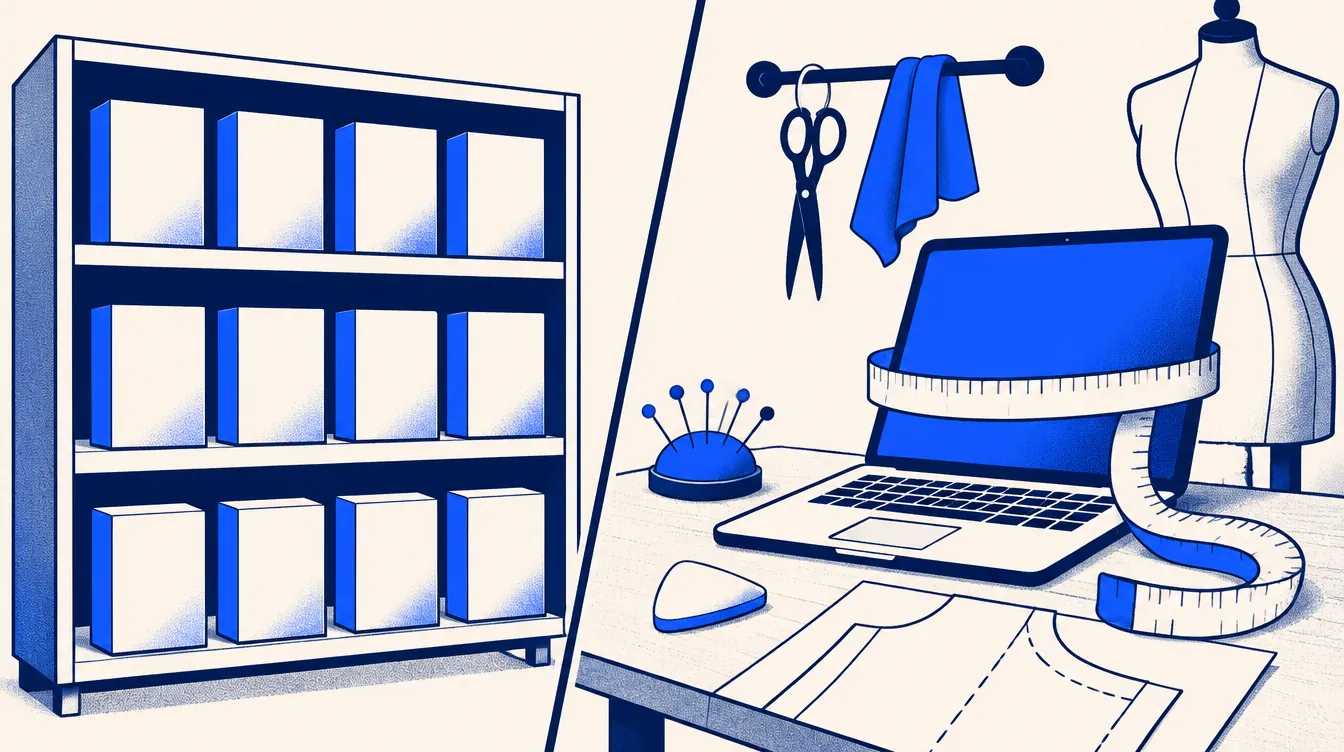
Most articles on this question are written by software agencies, and most of them conclude that you need bespoke software. We are a software studio too, so read this with that in mind. But the honest answer is that most small businesses should use off-the-shelf software for most things, and build only the part that is genuinely theirs.
This guide explains both terms, sets out the real advantages and disadvantages, gives you five questions to decide with, and covers the part nearly every comparison skips: who owns bespoke software under UK law.
What is bespoke software?
Bespoke software (also called custom, custom-built or custom-written software) is built for one organisation, around how it actually works. A booking system shaped around your own rules, a customer portal for your own services, or a tool that replaces the spreadsheet only one person understands are all bespoke. You commission it, you pay for the build, and with the right contract you own it.
What is off-the-shelf software?
Off-the-shelf software is a ready-made product sold to many customers, who all get the same thing. Xero and QuickBooks for accounts, Shopify for an online shop, Microsoft 365 for email and documents and HubSpot for a CRM are familiar examples. Today it is nearly always sold as a subscription, often priced per user per month, and the supplier decides what it does and when it changes.
Is proprietary software the same as off-the-shelf software?
No, the two words answer different questions. “Off the shelf” is about how software is sold: one product, many buyers. “Proprietary” is about who owns the code and on what licence you may use it. Most off-the-shelf software is proprietary to its vendor, and you rent a licence. Bespoke software is usually proprietary too, but proprietary to you, provided the contract says so.
Advantages and disadvantages, side by side
Question | Off the shelf | Bespoke |
|---|---|---|
Cost to start | Low: a free trial, then a monthly fee | High: you pay for the build up front |
Cost over time | Rises with users, plans and add-ons, and with price increases you do not control | Hosting plus a budget for changes; no per-user fees unless you choose them |
Time to get going | Same day | Weeks to a first release |
Fit with how you work | You adapt to the product | The product follows your process |
Who decides what changes | The vendor, for all its customers at once | You |
Your data | Held by the vendor; export options vary | In a database you own and can move |
Security updates and support | Included and handled by the vendor | Your developer’s job, so it must be in the agreement |
Main risk | Workarounds pile up; the vendor changes price or direction | A poor build or a developer who disappears |
The middle route most businesses miss
The choice is rarely all or nothing. Often the best answer is to keep the ready-made tools that already work and pay for the joins: orders from your shop flowing into your accounts without re-keying, new enquiries arriving in your CRM with the details already filled in, or a small customer portal that sits on top of the systems you have. That is what our integrations work is for, and it usually costs far less than replacing the tools.
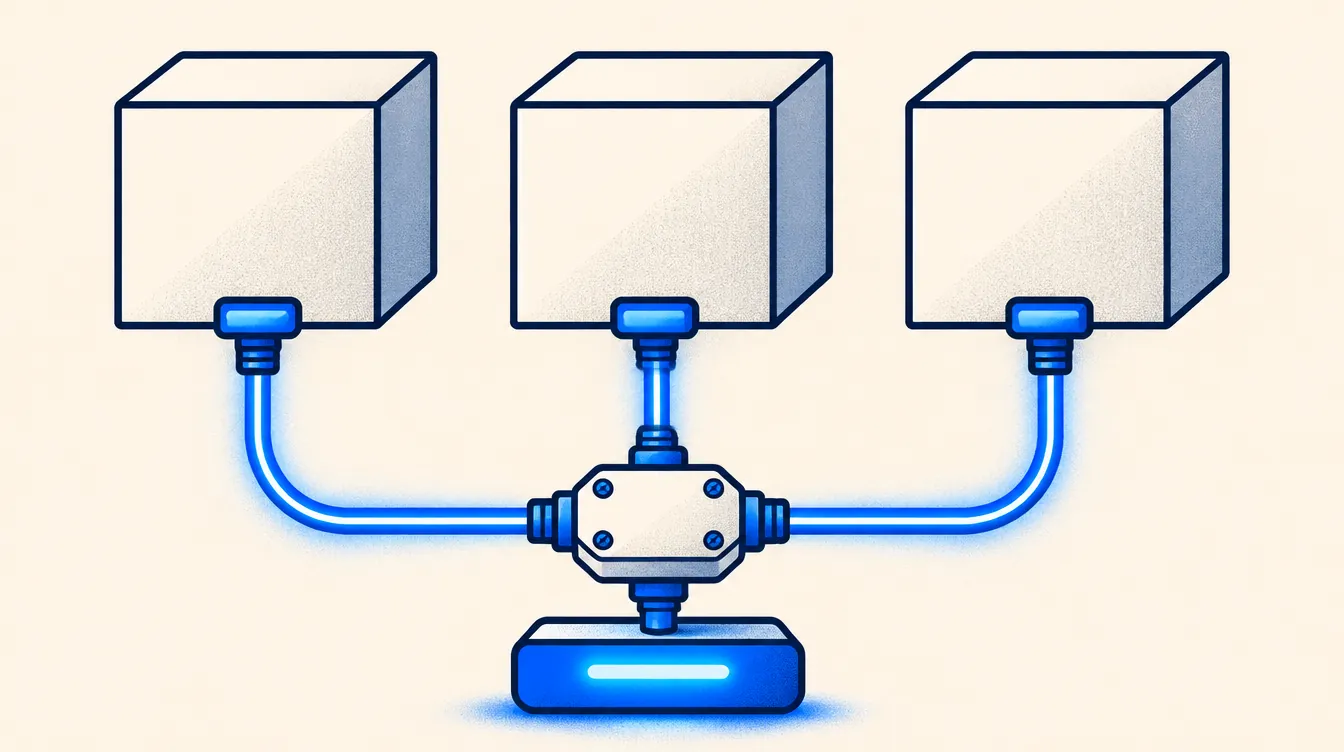
Even fully bespoke products are mostly off-the-shelf parts. Our own TenancyDesk takes payments through Stripe, sends email through Resend and keeps its data in Supabase. None of that is worth building again. The bespoke part is what makes it TenancyDesk: a list of 21 legal duties for every property and tenancy, and official documents produced with the government’s wording kept exactly as published. That is the general rule: buy the commodity, build the difference.
How to decide: five questions
1. Is this process what makes you different?
If the way you quote, schedule, deliver or report is part of why customers choose you, forcing it into a generic tool costs you something real. If it is the same as everyone else’s, like paying suppliers or running payroll, use the generic tool.
2. What will the subscriptions cost over three to five years?
Compare like with like. Take an illustrative tool at £30 per user per month (an example figure, not any product’s price) used by 12 people: £30 × 12 people × 12 months is £4,320 a year, or £21,600 over five years, before price rises or add-ons. Put that next to a build price plus its running costs; our guide to what an app costs to build and run in the UK has both. Bespoke is not automatically cheaper. It tends to win when many people use the software for years, or when you are paying for several tools to do one job.
3. Does a ready-made tool already do most of it?
If a product covers most of what you need, configure it and connect it, and build only the missing piece. Replacing a good product to gain a small extra is rarely worth it.
4. Do you need to own the code, the data or the roadmap?
If the software is the business itself, or you cannot accept a supplier changing its prices, features or terms underneath you, ownership matters. If not, renting is fine.
5. Who will look after it in three years?
Bespoke software needs updates, security fixes and changes for as long as you use it. Before you commission it, know who will do that, and make sure you could hand it to someone else if you had to.
Who owns bespoke software in the UK?
This is the question to settle before any bespoke project starts, and UK law does not give the answer most buyers assume. Under the Copyright, Designs and Patents Act 1988, a computer program is protected as a literary work. The Act then says “the author of a work is the first owner of any copyright in it”, with an exception for work made by an employee in the course of their employment, which belongs to the employer.
An outside developer or agency is not your employee. So unless your contract transfers the rights, the code they write for you belongs to them, and you may only have a licence to use it. The transfer has to be done properly, too: the Act says “an assignment of copyright is not effective unless it is in writing signed by or on behalf of the assignor”.
Before you pay for bespoke work, make sure you have:
- A written assignment of the copyright to you, effective on payment
- The source code in a repository in your own account
- Hosting, domain, database and payment accounts in your business’s name
- Enough documentation for another developer to pick the work up
At Nexa, clients own the code they pay for and the accounts it runs in. Whoever you work with, ask the question directly, and have a solicitor look at the contract if the project matters to you. This section explains the law; it is not legal advice for your situation.
What happens if your developer disappears?
With off-the-shelf software, the risk is the vendor changing course or closing, and the protection is being able to export your data. With bespoke software, the risk is losing the one person who understands it. The protection is the list above: the code, the accounts and the documentation all in your hands, built on common, well-supported technology that another capable developer would recognise.
When we would tell you not to go bespoke
- Accounts and VAT. Use Xero, QuickBooks or similar. Their makers keep up with HMRC’s requirements, such as Making Tax Digital, so you do not have to.
- Payroll, email and documents. Standard problems with good standard tools.
- A normal online shop. A hosted shop platform will do it faster and cheaper.
- A CRM before you have a sales process. Find out how you sell with a ready-made one first.
- Anything you cannot yet describe step by step. Bespoke software makes a process faster; it does not decide what the process should be.
We follow the same rule ourselves. A creator selling a handful of PDFs should use an existing platform. We built Bookstorez only because the marketplace is the business: shops, checkout, delivery and payouts for many sellers are the product itself.
One product, seen from both sides
TenancyDesk shows that the two categories are a matter of where you stand. For us, it is bespoke software: we designed and built it because the duty tracking, document generation and online signing it does is the business. For a landlord, it is off-the-shelf software: the same subscription for every landlord who signs up, which they can start today and someone else maintains. Building their own would make no sense, because their process, the legal duties of letting a home in England, is the same as every other landlord’s. That is the whole test in one example.
Frequently asked questions
What is bespoke software?
Bespoke software is software built for one organisation around how it actually works, such as a booking system, customer portal or internal tool made to its own rules. The business commissions and pays for the build and, with the right contract, owns the result. It is also called custom, custom-built or custom-written software.
What is off-the-shelf software?
Off-the-shelf software is a ready-made product sold to many customers who all get the same thing, usually as a monthly subscription priced per user. Xero, QuickBooks, Shopify, Microsoft 365 and HubSpot are common examples. The vendor decides what it does and when it changes.
What are the advantages and disadvantages of bespoke software?
Advantages: it follows your process, you control what changes, there are no per-user fees unless you choose them, and you can own the code and data. Disadvantages: a higher up-front cost, weeks before a first release, and responsibility for updates and support, which must be agreed with your developer.
What are the disadvantages of off-the-shelf software?
You adapt to the product rather than the other way round, workarounds build up, costs rise with users, plans and add-ons, the vendor can change prices or features for all customers at once, and your data sits on its systems with export options that vary.
What is the difference between proprietary and off-the-shelf software?
“Off the shelf” describes how software is sold: one product for many buyers. “Proprietary” describes who owns the code and the licence terms. Most off-the-shelf software is proprietary to its vendor. Bespoke software is usually proprietary too, but proprietary to the business that commissioned it, if the contract assigns the rights.
Who owns bespoke software in the UK?
Under the Copyright, Designs and Patents Act 1988, the author of a work is the first owner of the copyright, except for work made by an employee in the course of employment, which belongs to the employer. Code written by an outside developer therefore belongs to the developer unless the copyright is assigned to you, and an assignment is only effective in writing signed by or on behalf of the assignor.
Should a small business choose bespoke or off-the-shelf software?
Use off-the-shelf software for standard processes such as accounts, payroll, email and a normal online shop. Consider bespoke software when the process is what makes you different, when many people will use it for years, or when several subscriptions and workarounds cost more than a build. Often the best answer is in between: keep the ready-made tools and pay for custom connections between them.
Tristan Glaves
Founder, Nexa
Founder of Nexa. Background in software engineering and product. Builds bespoke software and digital products for UK businesses.
2–4 specific automation ideas for your business · No account needed